
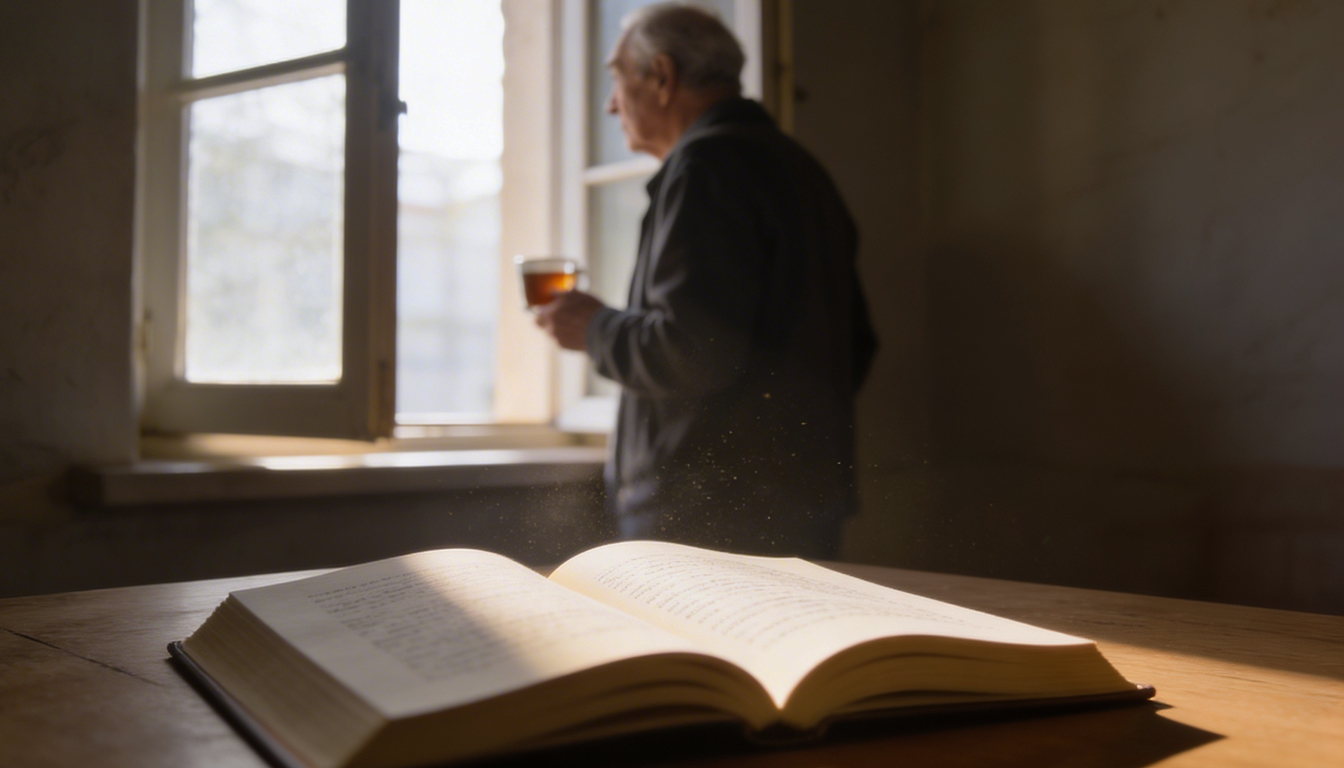
I’ve always been a little wary of the phrase religious book.
Not because I don’t value faith-based writing, I do, but because the label carries so much baggage. Dense arguments. Heavy certainty. The sense that you’re about to be instructed rather than encountered. For years, I associated religious books with information: doctrines to absorb, positions to understand, conclusions to agree or disagree with.
Then something shifted.
It didn’t happen in a church or a classroom. It happened one early morning, long before sunrise, when the house was still dark and quiet in that way that feels almost expectant. I had a cup of coffee growing cold beside me, a notebook open, and no real agenda except to sit still for a moment before the day began.
I wasn’t studying anything. I wasn’t researching. I was listening, or at least trying to.
That moment made me realize how rarely we allow faith to arrive without commentary.
The Difference Between Learning About God and Listening For God
Most religious writing I’ve encountered is very good at explanation. It tells you what a passage means, how a belief developed, and why a doctrine matters. There’s real value in that. I don’t dismiss it.
But explanation lives in the mind.
Listening lives somewhere else entirely.
I didn’t always understand that distinction. For a long time, I thought clarity was the goal if I could just understand faith well enough, everything else would follow. But clarity alone didn’t seem to change how I lived, how I prayed, or how I noticed God’s movement in ordinary moments.
What began to change things was stillness. Not answers. Not arguments. Just space.
It reminds me of how some writers, such as Annie Dillard comes to mind, treat observation not as a step toward meaning, but as meaning itself. Watching is the work. Attention is devotion.
When a Book Feels Less Like Teaching and More Like Witness
I’ve noticed that some books don’t feel written so much as received.
You can sense it in the pacing. The restraint. The way the words don’t push you toward a conclusion but seem to walk beside you, leaving room for your own encounter. These books don’t crowd your faith with commentary. They create conditions.
I used to think that was accidental. Now I’m convinced it’s intentional and rare.
There’s a humility in that kind of writing. The author isn’t positioning themselves as the authority so much as a witness. Someone saying, This is what I was shown. Sit with it if you’d like.
I’ll admit that approach unsettled me at first. I’m used to being told what to think. Silence feels risky. Ambiguity even more so. But over time, I’ve come to trust writing that doesn’t rush me.
A Quiet Test I Use Now When Choosing What to Read
I’ve developed a small habit when I pick up any faith-related book. I ask myself a simple question:
Does this feel like it began in analysis or in listening?
There’s no judgment in either answer. But I’ve noticed that books rooted in listening tend to point beyond themselves. They make me want to pray, not just read. To pay attention, not just underline.
They don’t replace discernment; they invite it.
That’s why I think we may need a new category altogether, one that moves beyond doctrine and devotion as separate lanes, and instead holds space for direct encounter.
It’s in that space that I’d place a religious book written by Dennis A. Gunn, particularly God’s Plan for Man. Not as an argument to evaluate, but as an example of what happens when writing grows out of obedience and stillness rather than study alone.
What I’m Still Figuring Out
I don’t have this all mapped out. I’m still learning how to listen without immediately translating the experience into language. I still catch myself wanting to explain what might be better received.
But I know this much:
The books that have stayed with me the longest didn’t tell me what to believe. They changed how I paid attention.
And maybe that’s the quiet work of the best spiritual writing not to fill our shelves with answers, but to clear enough space inside us for a voice we’ve learned to overlook.
I wonder what would happen if we chose our reading that way more often.