I can’t count how many nights I’ve spent staring at the ceiling, replaying the same question in a loop: What if I choose wrong?
You know the kind of night I mean, the room dim except for the blinking clock, the quiet feeling heavy, that mix of prayer and anxiety where you’re asking for a sign but also half-bracing for silence.
For years, that was my internal picture of “aligning with God’s will.”
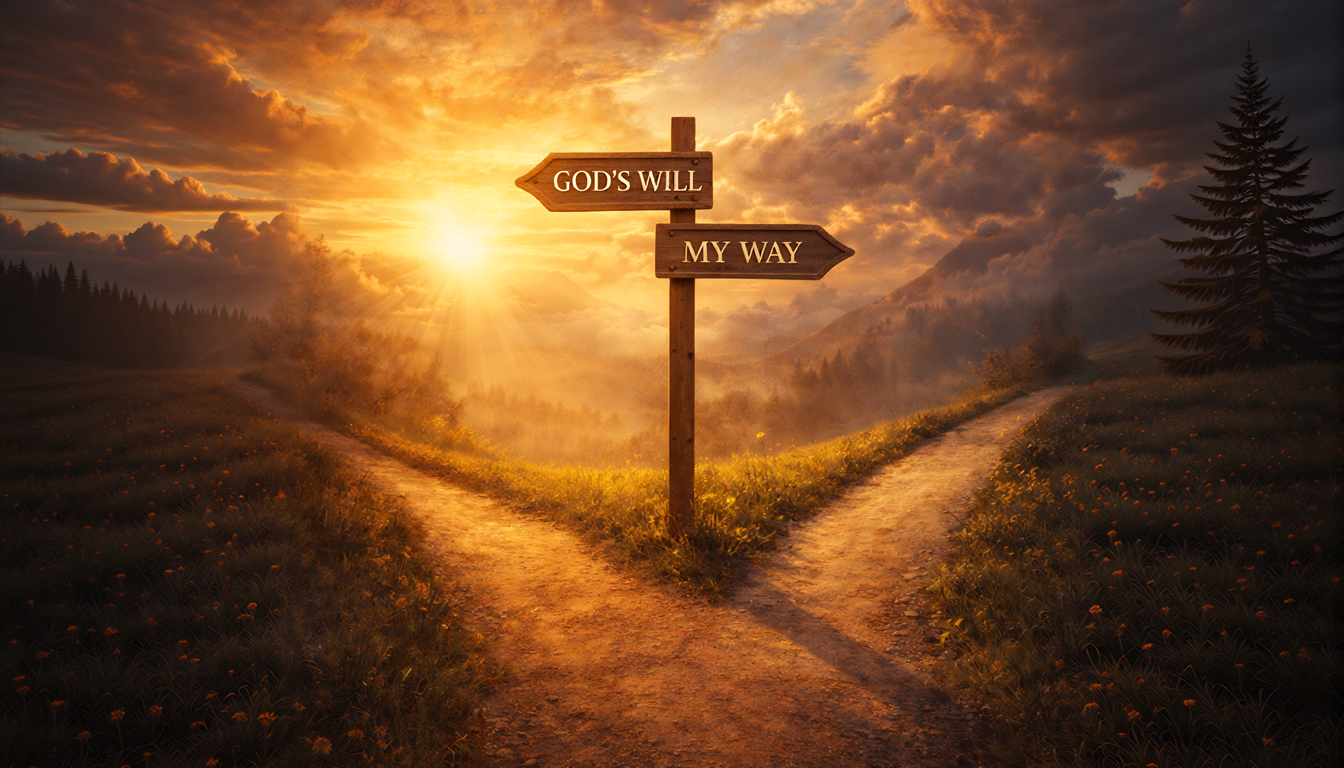
It felt like searching for a hidden map God had tucked somewhere inside my life. One wrong turn, I feared, would send everything spiraling off-course. I treated God’s will like a secret route I had to decipher before making a move.
But life isn’t a static landscape. It shifts under our feet.
Which means a map, at least the way I imagined it, was never going to work.
I didn’t see that clearly until one particular morning a few years ago.
The Quiet Moment That Shifted Everything
I was sitting on my porch just after sunrise, clutching a mug of tea I kept forgetting to drink. The world was still, the kind of still that only exists before most people are awake. I’d been wrestling with a decision for weeks, nothing dramatic, but significant enough that I felt paralyzed.
As I sat there, I watched the steam trail lazily from the mug. It drifted upward, not in a straight line but in a wandering, shifting motion, adjusting to the breeze moment by moment. And for some reason, that tiny detail made something click.
I remember thinking: Maybe aligning with God’s will isn’t about finding a fixed path. Maybe it’s about learning how to move with a slight breeze and not a strong wind.
Not guessing the next five miles, Not analyzing every potential outcome.
Just attending to the subtle pull in the present moment.
That image of possibility stayed with me, a small revelation I didn’t go looking for.
Why the “Map-Seeking Mindset” Exhausts Us
It took me a long time to realize how much pressure I’d placed on myself by imagining God’s will as something hidden, delicate, and easy to miss.
The map-model creates a few exhausting myths:
Myth 1: God’s will is a single correct decision .
One tiny dot we’re supposed to land on perfectly. But Scripture never presents God as a cosmic exam proctor waiting for us to slip up.
The older I get, the more convinced I am that God’s will is more like a direction than a destination, a way of walking, not a spot on the map.
Myth 2: Alignment will make life obvious.
I used to believe that if I were “truly aligned,” decisions would be crystal clear. But then I remember Jesus in Gethsemane perfectly aligned, yet agonizing.
Alignment doesn’t erase difficulty.
It steadies you inside it.
Myth 3: I can think my way into alignment.
This one grabbed me hardest. I’ve spent years reading, studying, analyzing, and assuming that if I gathered enough information, I would somehow achieve spiritual certainty.
But information is different from attunement.
Knowledge is not the same as wisdom.
It took a long time (and a few humbling personal missteps) to admit that.
Why a Compass Works Better Than a Map
Somewhere along the way, I started imagining alignment less as decoding instructions and more as tuning a compass.
A compass doesn’t tell you the entire route.
It just keeps pointing toward True North.
You still have to walk.
You still have to pay attention.
But you’re not left guessing.
That idea helped me breathe again.
And the more I sat with it, the more I began to see how deeply this metaphor resonates with Scripture’s description of the Father, Son, and Spirit, each playing a distinct role in our learning to walk with God.
Not as distant observers.
Not as harsh judges.
But as a relational, guiding presence.
The Trinity’s Quiet Work in Everyday Alignment
I don’t usually talk about theology in blog posts because it’s easy to make it sound academic or heavy. But this particular thread feels incredibly practical, something I’ve leaned on more times than I can count.
The Father as True North
A steady, unchanging orientation toward goodness and love. Alignment begins with trusting that His character sets the direction even when the terrain feels uncertain.
The Son as the Pattern
Jesus shows us what alignment looks like lived out in human skin. Not perfectly choreographed certainty, but obedient responsiveness.
The Spirit as the Real-Time Guide
This is the part I return to every time I feel stuck. The Spirit doesn’t give me a full map. He gives me a nudge. A settled peace. A warning hesitation. A scripture recalled at the right moment. The next step, not the next fifty.
It feels less like “figuring out” and more like “walking with.”
How I’ve Been Learning to Tune the Compass
I’m still not great at this. I still fall back into striving. But here are the postures that have helped me most:
1. Stillness over striving
I used to fill the silence with words, mostly mine. Now I try to sit in quiet enough to notice the gentle impressions I’d been missing.
2. Communion over calculation
Prayer used to feel like a task list. Lately, it feels more like companionship. Sometimes I don’t even bring a question, just my presence.
3. Wisdom over signs
For years, I asked God for clear signals, a door open here, a closed door there. Now I find myself asking instead:
“Give me wisdom for the next faithful step.”
It’s a different request. And it leads to a different kind of peace.
What Alignment Actually Feels Like
The best word I have is rest.
Not in the sense of inactivity, but in the sense of inner steadiness. There’s a quiet assurance that you are facing the right direction, even if the path ahead is foggy.
And the fruit of that alignment, at least in my life, has often shown up in small ways:
A softened response.
A surprising clarity.
A renewed willingness to move forward without fear.
Not dramatic.
Just faithful.
P.S. This idea, the shift from striving to abiding, is something I explore more deeply in God’s Plan for Man. Not as a doctrine to master, but as a lived journey I’m still on.